Book Appointment Now
Orthodontic Braces Types: Styles + Images + Complete Guide to Choosing the Best Option
Introduction
Your smile is the essence of your beauty, and orthodontic treatment is not just a way to achieve an attractive appearance, but also a comprehensive medical solution that improves oral functions such as chewing, speech, and proper jaw alignment.
Many people search for “orthodontic braces types” to find the most suitable option or to understand the advantages and disadvantages of each type.
In this comprehensive guide by Dr. Mohamed Fahmy’s Clinic, we will go through all types of orthodontic braces with pictures, explain the differences between them, and provide practical tips to help you choose the right type for your case, while answering the most common questions, so you can achieve a healthy and beautiful smile.
Table of Contents
What is Orthodontics and Why Is It Used?
Orthodontics is a branch of dentistry that specializes in diagnosing and correcting teeth and jaw alignment issues.
It is used to treat problems such as:
- Teeth misalignment (crooked teeth).
- Protruding front teeth.
- Severe crowding and overlapping teeth.
- Large gaps between teeth.
- Jaw misalignment, medically known as malocclusion.
The goal of orthodontic treatment is not limited to improving appearance; it also includes:
- Enhancing the overall health of the mouth and gums.
- Making teeth easier to clean and preventing plaque and bacteria buildup.
- Preventing future dental problems such as cavities and gum diseases.
Importance of Orthodontic Treatment
Orthodontics is not just a cosmetic treatment; it has many long-term benefits, including:
- Improving the appearance of your smile and boosting self-confidence.
- Correcting speech problems caused by misaligned teeth.
- Enhancing chewing and digestion by fixing tooth positions.
- Preventing tooth wear caused by poor bite alignment.
- Making it easier to clean teeth and reduce the risk of cavities.
Types and Styles of Orthodontic Braces
There are many types of orthodontic braces designed to suit different cases.
The right type depends on the severity of the problem, the patient’s age, and personal preferences regarding appearance and budget.
Here’s a detailed explanation of each type:
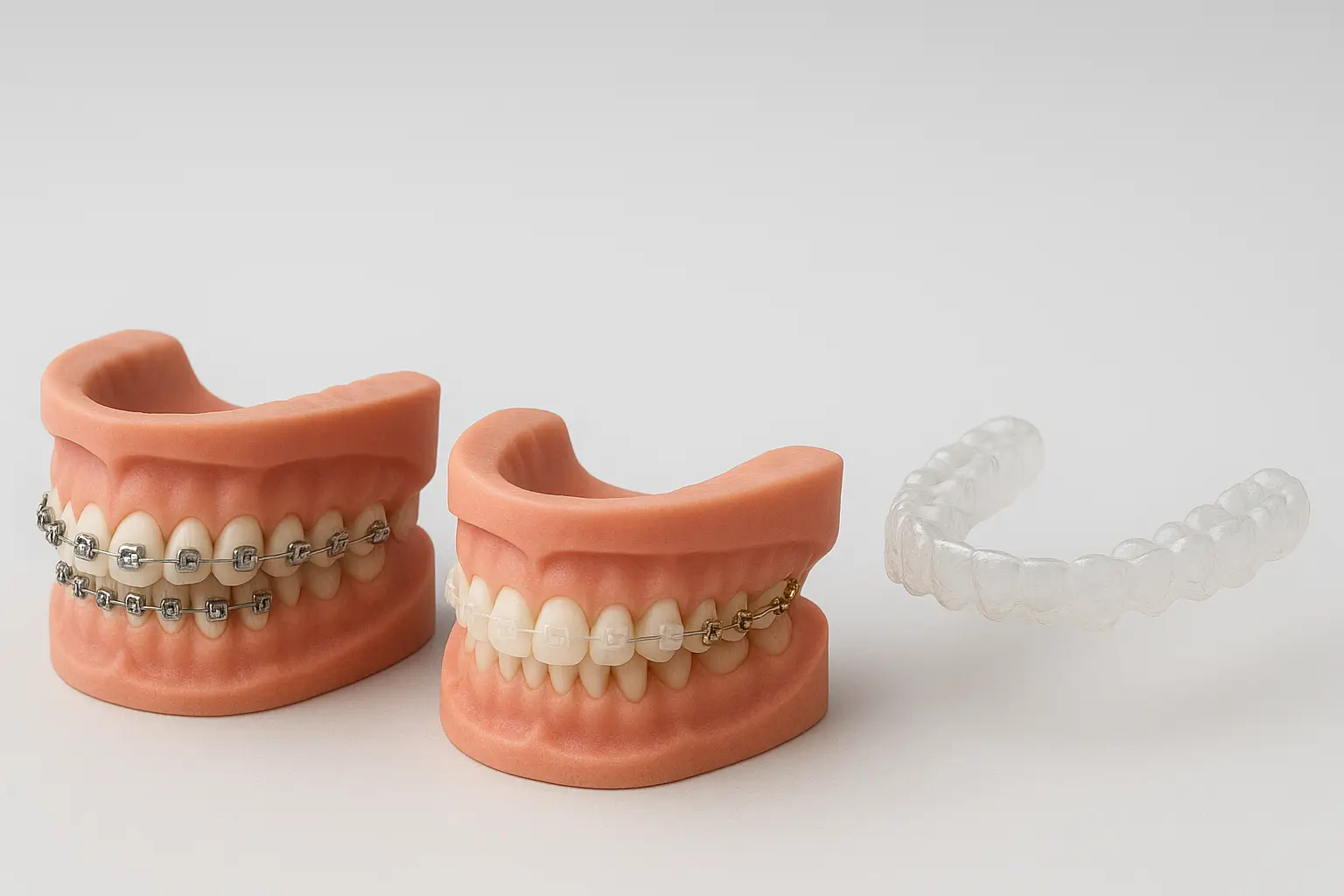
1. Traditional Metal Braces
Traditional metal braces are the oldest and most commonly used type of braces.
They consist of metal brackets and wires attached to the teeth using elastic bands.
Advantages:
- Highly effective in correcting almost all dental problems.
- The least expensive option compared to other types.
- Strong and reliable results even in complex cases.
Disadvantages:
- Highly visible appearance, which may cause embarrassment.
- Difficulties in cleaning teeth during treatment.
- May cause some discomfort or pain at the beginning.
Best For:
Severe cases such as extreme crowding or major bite misalignments.
2. Self-Ligating Braces
Self-ligating braces are similar to traditional metal braces but use a modern system called self-ligation, which holds the wires in place without elastic bands.
This reduces friction and allows teeth to move more freely and efficiently.
Advantages:
- Fewer visits to the clinic are needed.
- More comfortable for the patient and less pressure on the teeth.
- Treatment time may be noticeably shorter.
Disadvantages:
- More expensive than traditional braces.
- Slightly bulkier brackets.
Best For:
Moderate to severe cases where faster treatment is desired.
3. Ceramic Braces
Ceramic braces are an ideal option for adults because the brackets are made of a tooth-colored ceramic material, making them less visible.
Advantages:
- More aesthetically pleasing than metal braces.
- Less noticeable, making them suitable for socially active individuals or professionals.
Disadvantages:
- More fragile than metal braces and may break easily.
- Higher cost compared to traditional braces.
- Can stain if not maintained properly.
Best For:
Students, employees, or anyone who wants a less noticeable orthodontic option.
4. Lingual Braces
Lingual braces are attached to the back side of the teeth, making them virtually invisible from the outside.
Advantages:
- Completely invisible, maintaining a natural smile appearance.
- Just as effective as other braces for most issues.
Disadvantages:
- Harder to clean and maintain.
- May temporarily affect speech.
- Much higher cost compared to other types.
Best For:
People who value appearance and do not want their braces to be seen at all.
5. Clear Aligners
Clear aligners, like Invisalign, are among the latest advancements in orthodontics.
They are transparent, removable trays custom-made for each patient and can be taken out while eating or brushing.
Advantages:
- Nearly invisible when worn.
- Can be easily removed for meals and cleaning.
- Comfortable to wear and does not cause mouth injuries.
Disadvantages:
- Higher cost.
- Not suitable for very complex cases.
- Requires strict discipline to wear for 20–22 hours a day.
Best For:
Mild to moderate cases, especially for adults who value appearance and comfort.
Comparison Table of Orthodontic Braces Types
| Type | Aesthetic Visibility | Cost | Treatment Duration | Best For |
| Traditional Metal | Low | Low | 12 – 36 months | Severe cases |
| Self-Ligating | Medium | Medium | 12 – 30 months | Moderate to severe cases |
| Ceramic | High | High | 12 – 30 months | Adults |
| Lingual | Very High | Very High | 18 – 36 months | Appearance-focused individuals |
| Clear Aligners | Very High | Very High | 6 – 24 months | Mild to moderate cases |
Tips for Choosing the Right Type of Braces
Choosing the right type of braces is not a random decision — it depends on several factors you should discuss with your orthodontist:
- Severity of the issue:
Complex cases often require traditional metal braces. - Age:
Some types, like clear aligners, are better suited for adults. - Appearance:
If you care about invisibility, lingual braces or clear aligners are ideal. - Budget:
Keep in mind that lingual braces and clear aligners are the most expensive. - Treatment time:
Some types take longer to deliver results than others.
Orthodontic Braces Costs in Egypt (2025)
The cost varies depending on the type, the condition of the teeth, and the orthodontist’s expertise.
Here are approximate price ranges:
- Traditional metal braces: EGP 8,000 – 12,000
- Ceramic braces: EGP 15,000 – 25,000
- Clear aligners: Starting from EGP 25,000 and up to 45,000
- Lingual braces: Starting from EGP 30,000
Note: Prices are approximate. It’s best to book a personal consultation with Dr. Mohamed Fahmy for an accurate cost estimate.
Frequently Asked Questions (FAQ)
1. Can braces be fitted at any age?
Yes, braces can be fitted for both children and adults. However, starting at a younger age often leads to faster and easier results.
2. Are braces painful?
You may experience some pain or pressure during the first few days after placement or after adjustment sessions, but it gradually fades.
3. How long does orthodontic treatment take?
Treatment duration depends on the case and type of braces, typically ranging from 12 to 36 months.
4. How much do braces cost in Egypt?
Costs depend on the type and condition of the teeth. Generally, traditional metal braces are the least expensive, while clear aligners and lingual braces are the most costly.
5. Can clear aligners be removed while eating?
Yes, clear aligners can be removed during meals or while cleaning teeth, but they must be worn for most hours of the day.
Conclusion
Orthodontic treatment is an investment in your health and appearance.
Choosing the right type depends on your specific case, which is why we recommend booking a consultation with Dr. Mohamed Fahmy for an accurate evaluation and customized treatment plan.
A healthy, beautiful smile is the first step toward renewed confidence in your life — don’t hesitate to take this important step to improve both your smile and quality of life.